AstroSage: Broadly Accurate, Genuinely Generous — but Not the Last Word
The most comprehensive free Vedic engine online — broadly accurate and genuinely generous. Two things keep it from being the last word: a nuance it misses (daylight saving — easy for an India-built tool, decisive for a birth abroad) and an accuracy gap (it asks your birth time to the second, then places a cusp Moon a full minute off — into the wrong star). In astrology, both decide the answer.
1. The nuance — daylight saving, and one missed hour becomes a different chart
Start with the forgivable failure. India has never used daylight saving, so an engine built for the Indian market has little reason to sweat it — a fair nuance to under-weight. But juno.date serves births anywhere, and abroad the nuance bites hard. Our first birth, "Kalki": 3 June 2012, 20:57, Anchorage, Alaska. Anchorage's standard offset is UTC−9 — but on that June date Alaska kept daylight saving (UTC−8; US DST ran 11 March – 4 November 2012). The correct clock is −8. AstroSage cast the chart on −9 — one phantom hour.
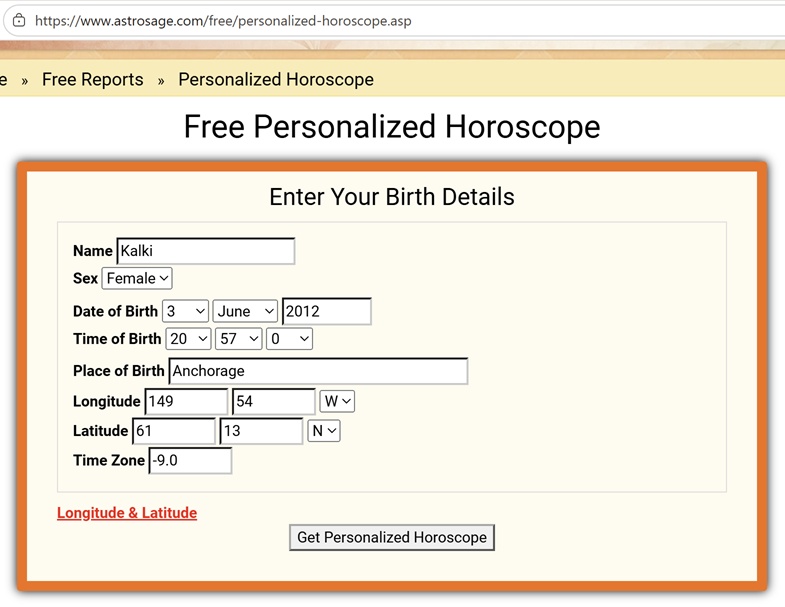
One hour is enough here, because this Moon sits right on a nakshatra edge — the Anuradha → Jyeshtha boundary at Scorpio 16°40′. At the true time the Moon is 23′ short of it; the phantom hour carries it 15′ past. So the birth star itself flips — and everything keyed to it follows:
| Kalki · 3 Jun 2012, 20:57, Anchorage | juno.date (−8, correct) | AstroSage (−9, DST missed) |
|---|---|---|
| Moon → nakshatra | Scorpio 16°17′ — Anuradha (pada 4) | Scorpio 16°55′ — Jyeshtha (pada 1) |
| Birth-star lord | Saturn | Mercury |
| Gana / Nadi | Deva / Madhya | Rakshasa / Adi |
| First Vimshottari Mahadasa | Saturn | Mercury (their "Bal. Mercury 16Y") |
| Ascendant (lagna) | Libra | Scorpio |
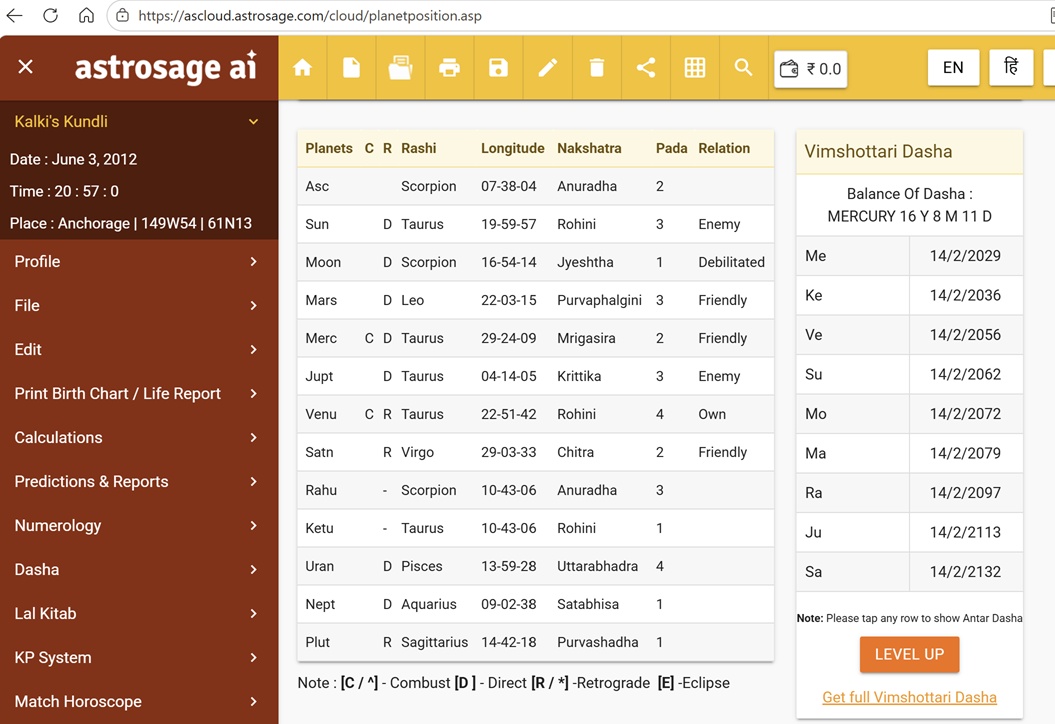
Read that column again. A single missed hour — the kind of slip a user makes by entering their city's "normal" time zone — and AstroSage hands back the wrong birth star, its wrong lord, the wrong gana and nadi, the wrong Vimshottari dasa, and the wrong ascendant. On a matching site each of those drives the result: the birth star sets the porutham and guna, the dasa sets the timing, the ascendant sets every house. The whole foundation moves.
The cause is unglamorous, and it is the single most common way a chart goes silently wrong: time-zone and daylight-saving handling. A place has no one fixed offset — it depends on the date. Ask a user to type an offset and most give the standard one, missing the DST switch, exactly as here. juno.date never asks: it resolves each birthplace to its IANA time zone and applies the historically-correct rule for that exact date (Anchorage, 3 June 2012 → AKDT, −8). To be scrupulously fair, AstroSage's arithmetic on the −9 instant is perfectly correct — the −9 was simply the wrong instant, and it is plumbing, not astrology. But it is exactly where accuracy is won or lost before a single graha is placed — and for a diaspora birth, it is not optional.
2. The accuracy gap — a fraction of an arc-second decides the star
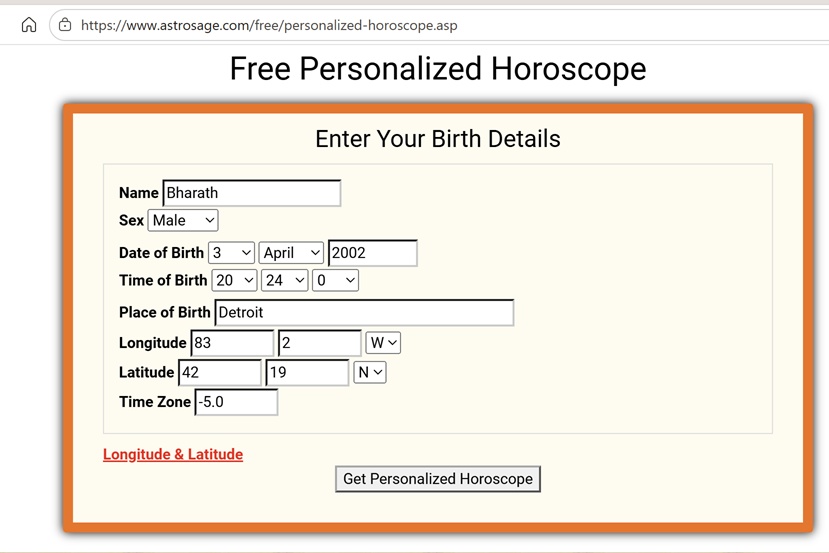
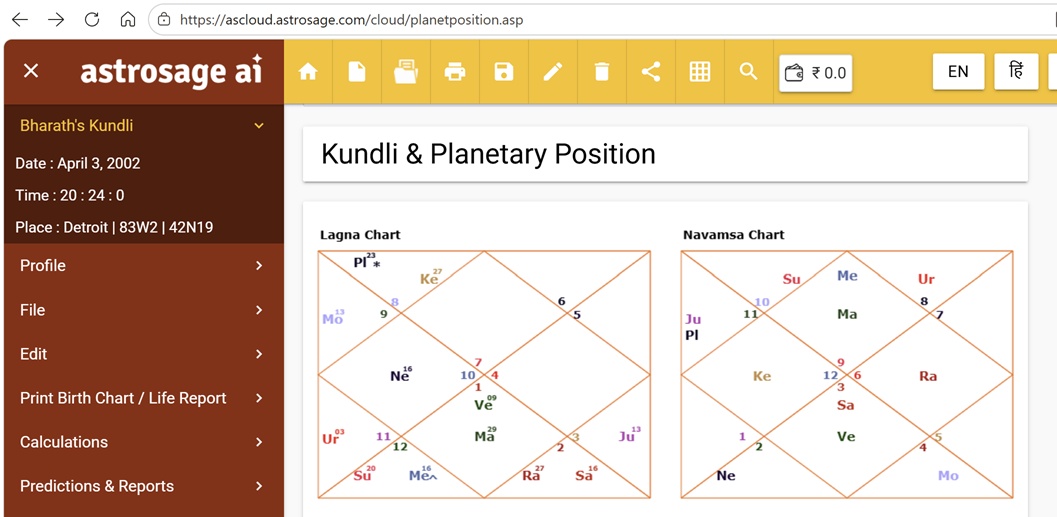
The second failure is not a nuance you can wave off; it is accuracy, and it is the one that bars any tool from calling itself the last word. Our test person, "Bharath": born 3 April 2002, 20:24, Detroit. Nothing exotic — except that his Moon fell within a whisker of a nakshatra boundary: the Mula / Purva Ashadha cusp at 13°20′ Sagittarius.
AstroSage's reading: Moon at Sagittarius 13°19′60″ — i.e. exactly 13°20′ — labelled Mula, pada 4, with the Ketu dasa balance sitting at zero. In other words, the very last instant of Mula.
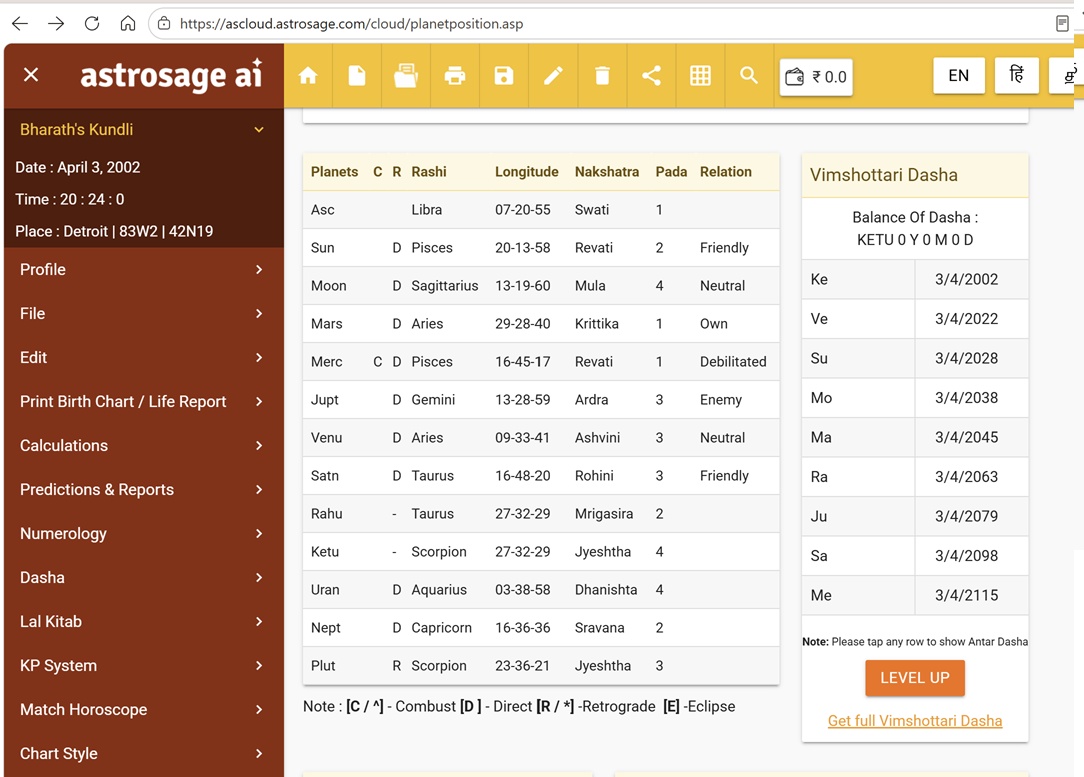
So we asked the one authority that outranks any website — the JPL DE440 ephemeris — for the Moon's true sidereal position at that exact instant (2002-04-04 01:24:00 UTC, Lahiri ayanamsa). Here is where each engine lands:
| Source | Sidereal Moon | vs true | Nakshatra |
|---|---|---|---|
| JPL DE440 (true UTC) | 253.34225° | — | Purva Ashadha |
| juno.date | 253.3422° | −0.3″ | Purva Ashadha ✓ |
| AstroSage | 253.3333° | ~32″ behind | Mula ✗ |
juno.date sits 0.3 arc-seconds from the true ephemeris; AstroSage sits ~32″ — roughly 100× further off — and that gap is what puts it on the wrong side of the cusp. In time, the star truly turns over at about 20:23: juno.date changes it there; AstroSage a full minute later, at 20:24:00. So for this birth, DE440 and juno.date read Purva Ashadha; AstroSage reads Mula — and juno.date never even asked for the seconds of the birth.
This is not hair-splitting, least of all on a matching site. Mula and Purva Ashadha are two different birth stars, with different lords (Ketu vs Venus), different gana, yoni and nadi. For this person, that single ~30-arc-second call changes his janma nakshatra — and with it every porutham and guna his marriage compatibility is built from. A tool can display seconds and still hand you the wrong star.
The same birth, both engines — where they part
Here is the telling part: the two charts are otherwise identical. juno.date computes every graha's sign exactly where AstroSage's chart above places it. The engines diverge on one value only — the Moon's nakshatra — because it sits on the cusp:
| For "Bharath" | juno.date (matches DE440) | AstroSage |
|---|---|---|
| All 9 grahas' signs + Lagna | identical between the two engines | |
| Moon nakshatra | Purva Ashadha (pada 1) | Mula (pada 4) |
| Nakshatra lord | Venus | Ketu |
| First Vimshottari dasa | Venus | Ketu (bal. 0) → Venus |
Same sky, same placements — one label flips, and it is the label AstroSage gets wrong.
The fair caveat, stated plainly: this is an edge case — a Moon on a cusp — and for the overwhelming majority of births AstroSage's arithmetic is exactly right, as we confirm below. It matters here because juno.date tracks the JPL ephemeris to a fraction of an arc-second, so at the one point where a fraction decides the answer, it lands on the correct side. Looking more precise is not the same as being more accurate.
A nuance on one birth, a fraction of an arc-second on another — neither is a scandal, and together they still leave one of the best free engines in the world. But they answer the only question that matters for a tool people hand a marriage decision to: is it the final authority? It is not. Here is why it is nonetheless the one to beat.
3. Who AstroSage is — and what it gets right
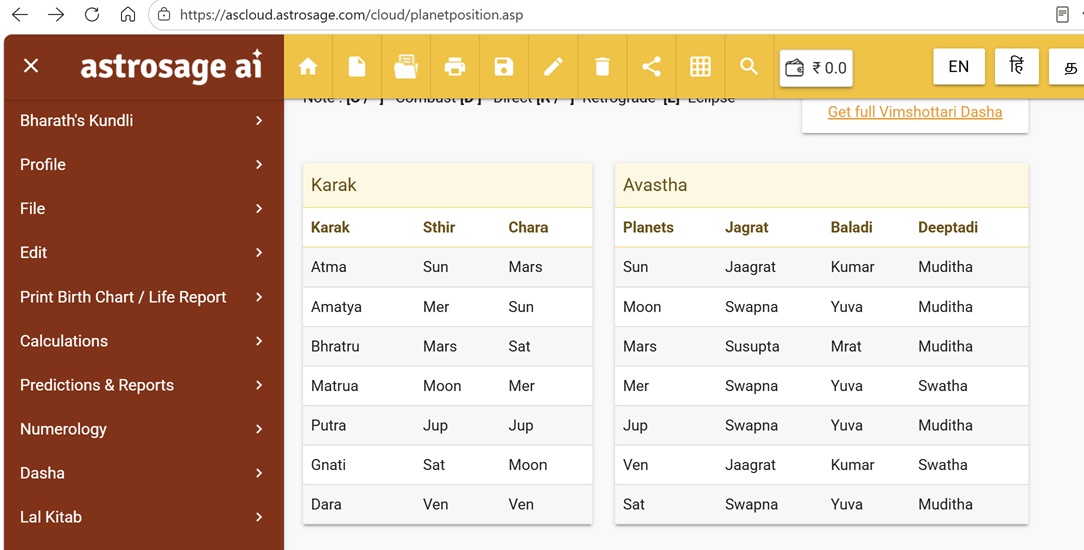
None of the above is a takedown, and AstroSage has earned genuine respect. It is one of the oldest and most complete Vedic platforms online, and its free tier is unusually, almost startlingly generous. Without paying a rupee you get the full Guna Milan with the koota numbers and written interpretations, a 50-plus-page life-report PDF, the annual Varshaphal, Lal Kitab predictions, the complete Vimshottari mahadasha, Gochara transits, the full sixteen Shodashvarga charts, Ashtakavarga, and the Sade Sati timeline.
Credit where it is genuinely due: their Sade Sati page closes with a rational, non-fear caveat — telling readers in so many words not to take the forecast too seriously and that Saturn's period is not automatically malefic. That is the opposite of the fear-selling much of the industry runs on, and it speaks well of them.
The business model leans on that generosity. The charts and reports are free; the revenue comes from a substantial layer of upsell wrapped around them — paid consultations, premium PDF reports, a gemstone / yantra / rudraksha store, and AstroSage Matrimony — with a good deal nudged under "order now" and some deeper analyses gated behind payment. It is, in truth, more upsell-heavy than it first looks. But the thing that matters most is not held hostage: your chart, your guna, your dasha are free to see — which is more than several competitors manage. That balance — generous where it counts, commercial around the edges — is one we respect, and juno.date keeps the depth free as well.
4. How we know — because we checked ourselves against them, too
We do not grade competitors on vibes, and we do not exempt our own engine. Using the same births, we put the truth and both engines side by side — the raw JPL DE440 ephemeris is the truth; juno.date and AstroSage are each measured against it — so you can see exactly how far each sits from the sky:
| What we compared | JPL DE440 (the truth) | juno.date | AstroSage |
|---|---|---|---|
| Nirayana longitudes — 7 classical grahas + Ascendant | the reference (0″) | ≤ 0.4″ from truth | ≈ 32″ – 1.6′ from truth |
| Rasi, Nakshatra, Pada, Lagna, dasa balance | the reference | Exact | Exact |
| Guna Milan — all 8 kootas (36-guna) | derived score † | juno.date and AstroSage agree — 8 / 8 | |
| Ashtakavarga — all seven Bhinna charts | derived score † | juno.date and AstroSage agree — 12 / 12 | |
† Guna Milan and Ashtakavarga are scoring systems computed from the planetary positions — not quantities the ephemeris itself outputs — so there is no DE440 value to check them against directly. They inherit the arc-second accuracy of the positions in the top row; the meaningful independent check is against another engine that computes them, which is the AstroSage column.
Read the first row carefully — it is the whole thesis in miniature. Our seven grahas sit sub-arc-second from DE440 (within ~0.4″, on births from 1997 to 2002), while AstroSage sits up to about an arc-minute away. It is not only the Moon on its cusp; it is the same small edge, everywhere. That same cross-check also caught a bug in our own engine — a single wrong value in our Venus Ashtakavarga table — which we found and fixed on the spot. We answer to the ephemeris, not to our pride. So read this fairly: AstroSage is accurate, generous and largely trustworthy; we are simply, measurably, a little closer to the sky.